Top 10 questions hiring web development agency

Top 10 Questions to Ask Before Hiring a Web Agency

Hiring the wrong web development agency doesn’t just waste money it costs you months of delays, a website that doesn’t convert, and another redesign project six months down the line. If you’re a small business owner in Delhi NCR comparing agencies right now, the questions you ask before signing anything matter more than the pitch you’re shown.

We’ve rebuilt more websites for clients who got burned by their first agency than we’d like to admit. Most of those problems trace back to questions that were never asked upfront. Here are the 10 that actually matter.

1. Will I own my website’s code and content once it’s built?

This is the single most important question, and the one most business owners forget to ask. Some agencies build your site on locked platforms or proprietary systems where you can’t move your content elsewhere without paying them again. Before signing anything, get written confirmation that you’ll own full rights to your code, content, and domain. If an agency hesitates to answer this clearly, that’s a red flag.

2. What exactly is included in the price, and what costs extra later?

A quote of ₹15,000 can quietly become ₹45,000 once you add hosting setup, revisions, stock images, and “support” fees. Ask for a line-item breakdown before you agree to anything. At Code To Craft, our business website packages start at clearly stated tiers ₹9,999 for a Starter site, ₹19,999 for a Business site with no surprise add-ons buried in the fine print.

3. How long will the project actually take, and what happens if it’s delayed?

Every agency promises a fast turnaround during the sales call. Ask instead: what happens if the timeline slips? Is there a penalty clause, or does the delay just become your problem? Get a realistic delivery date in writing, not a verbal estimate.

4. Can I see real websites you’ve built for businesses like mine?

A polished portfolio slide isn’t proof of anything. Ask for live links to sites the agency has actually shipped, ideally in your industry or a similar one. Check if those sites load fast, work on mobile, and still look maintained. We’ve built and continue to support 120+ websites for 60+ clients across Delhi NCR ask any agency for numbers like that, not just screenshots.

5. Will the website be built for SEO from day one, or is that a separate service?

A beautiful website that nobody finds on Google is a wasted investment. Ask whether SEO fundamentals clean URLs, schema markup, mobile speed, meta tags are baked into development, or if it’s an expensive add-on you’ll need to buy separately later. Our corporate website development process includes technical SEO setup by default, not as an upsell.

6. Who handles the website after it’s live and for how long?

Websites break. Plugins go out of date, forms stop working, security patches get missed. Ask exactly what happens the day after launch: is there a maintenance plan, who do you call, and what’s the response time? This is one of the most overlooked questions, and one of the most expensive to get wrong. Our website maintenance and support plans exist specifically because “we’ll figure it out later” isn’t a real answer.

7. Do you build on a platform I can actually manage myself?

If you’re not technical, ask for a plain demonstration of how you’ll update prices, add a blog post, or change a phone number after launch. Some agencies build sites so complex that you’re forced to pay them for every small edit. A good agency hands you a website you can actually run day-to-day, not one that keeps you dependent on them for text changes.

8. What’s your process if I need an online store, not just a brochure site?

eCommerce is a different discipline from a standard business website payment gateways, inventory, checkout flow, and product SEO all need specific expertise. If you’re planning to sell online, ask directly whether the agency has shipped real stores before, and on which platform. We handle this through dedicated eCommerce website development and Shopify development tracks, each with its own process.

9. What happens if I’m not happy with the design?

Ask how many rounds of revisions are included, and what counts as a “revision” versus a scope change they’ll charge for. Vague answers here usually mean disputes later. Get the revision policy in writing before the project starts, not after you’ve already seen the first draft.

10. Why should I trust a remote, no-office agency with my website?

This is a fair question to ask any agency, including us. The honest answer: a physical office adds overhead cost that gets passed to you, not quality. What actually matters is whether the team responds fast, delivers on time, and stands behind their work after launch. Being remote-first lets agencies like Code To Craft keep pricing lower and stay flexible on calls and revisions without cutting corners on the site itself. If a business asks us this directly, we’re happy to walk through our process and past client sites as proof.

The Bottom Line

Most bad agency experiences aren’t caused by bad developers they’re caused by unclear expectations set before the project even started. Asking these 10 questions upfront takes 20 minutes and can save you months of frustration and thousands of rupees in rework.

If you’re currently comparing agencies in Delhi NCR and want straight answers to all 10 of these, our custom website development team is happy to walk you through pricing, timelines, and past work with no pressure.


Frequently Asked Questions

How much does it cost to hire a web development agency in Delhi NCR?

Pricing typically ranges from ₹9,999 for a basic starter site to ₹19,999+ for a full business website, with custom quotes for enterprise projects depending on features like eCommerce, custom design, and ongoing maintenance.

Should I hire a freelancer or an agency for my business website?

Freelancers can be cheaper upfront but often disappear after launch, leaving you without support. Agencies typically offer accountability, a defined process, and ongoing maintenance which matters more once your site is actually live and generating leads.

How long does it take to build a business website?

A standard business website typically takes 1–3 weeks depending on the number of pages and revisions required. eCommerce or custom-coded projects can take longer due to additional integrations.

Do I need to be technical to manage my website after it’s built?

No. A well-built website should let you update text, images, and prices yourself through a simple dashboard, without needing to know code or call your developer for every small change.

Is it safe to hire a remote, no-office web development agency?

Yes, as long as the agency has a verifiable track record, real client sites you can check, and clear communication channels. A physical office has no bearing on code quality it mainly affects overhead cost, which often gets passed on to you as a client.
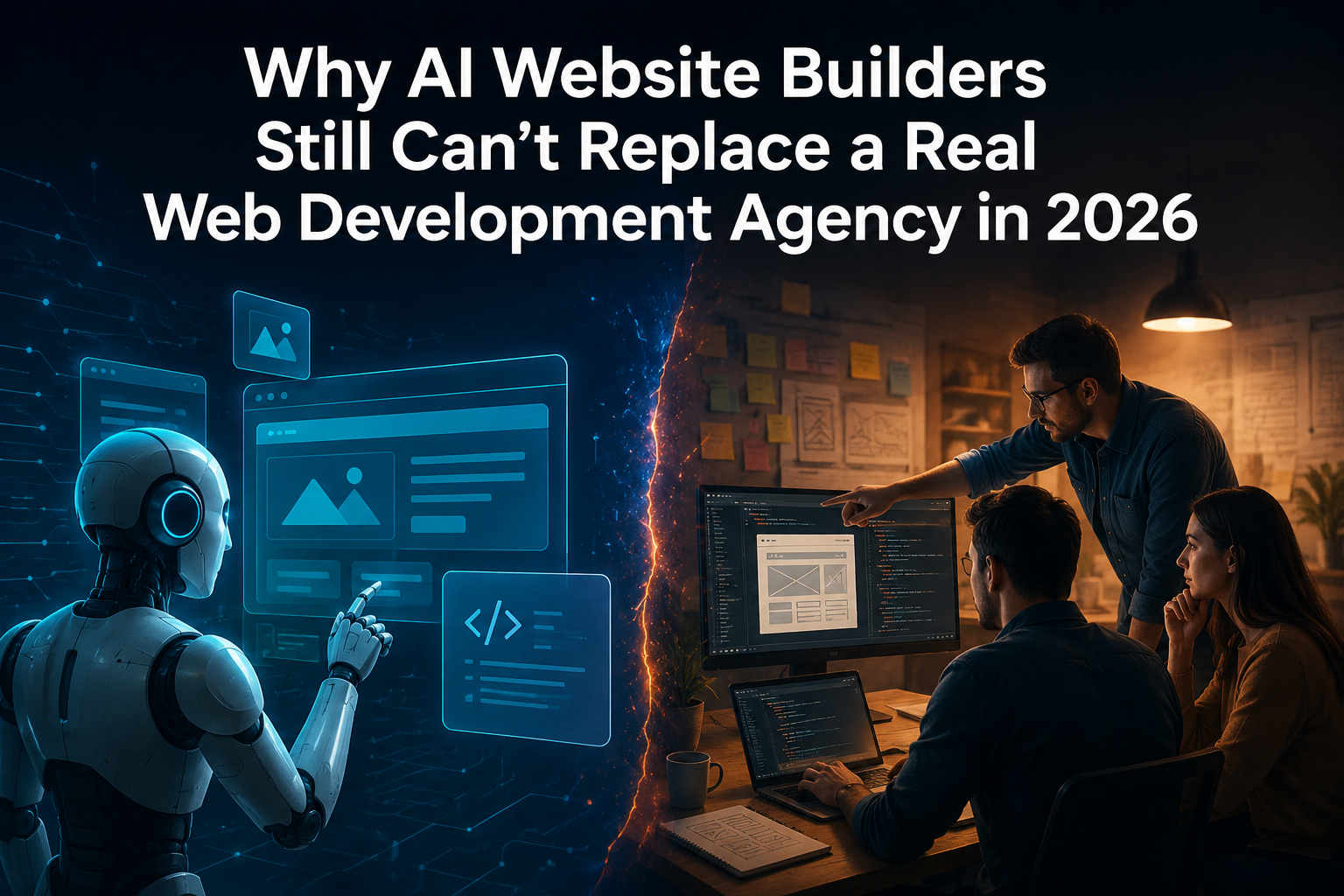
Why AI Website Builders Still Can’t Replace a Real Web Development Agency in 2026

Ai website vs Agency Website

Every few months, a new AI tool promises to build you a “complete business website in 60 seconds.” Type a prompt, pick a template, and boom your site is live. It sounds like the end of web development agencies as we know them.

It isn’t.

What these tools are actually good at is producing something that looks like a website fast. What they’re not good at is producing something that works like a business asset one that ranks on Google, converts visitors into customers, and doesn’t fall apart the moment you need something custom. At Code To Craft, we get calls every month from business owners who tried the AI-builder route first and came to us afterward to fix it, rebuild it, or replace it entirely. This post breaks down exactly why that happens, and where a real web development agency still wins.

What AI Website Builders Actually Do Well

To be fair, AI website builders aren’t useless. They’re a reasonable starting point if:

  • You need a placeholder page today and can fix it later
  • You have zero budget and zero customers yet
  • You just want to test an idea before investing in it properly

That’s the honest use case. The problem starts when business owners treat an AI-generated site as a finished, production-ready website because that’s exactly what most of them are not.

Where AI Website Builders Fall Short

1. Generic, Templated Design

AI builders pull from a limited pool of design patterns. Thousands of businesses end up with visually similar layouts, similar color schemes, and similar section structures. Your website is often the first impression a customer forms of your business and “looks like everyone else’s AI site” is not the impression you want to make.

2. Weak, Boilerplate SEO

This is the big one. Most AI-generated sites ship with:

  • Auto-generated, generic meta titles and descriptions
  • No proper schema markup (Organization, LocalBusiness, Service, FAQPage)
  • Thin, keyword-stuffed content that doesn’t actually answer what your customers search for
  • No internal linking strategy

Search engines and increasingly AI answer engines like Google AI Overviews reward sites with genuine topical depth, structured data, and clear entity signals. An AI builder doesn’t do strategic SEO. It fills in a template. If you want to actually show up when someone searches “website development company in Faridabad,” a templated AI site with no SEO strategy behind it simply won’t compete.

3. No Real Strategy Behind the Structure

A real web development process starts with understanding your business, your customers, and your competitors then builds a site structure and content plan around that. AI builders skip straight to output. There’s no discovery call, no competitor analysis, no conversion-focused layout decisions. You get a website. You don’t get a strategy.

4. Limited Customization When You Actually Need It

The moment your business needs something specific a custom quote calculator, a booking system tied to your operations, a unique checkout flow, an integration with your CRM most AI builders hit a wall. You’re boxed into their component library. Real development, by contrast, can build exactly what your business needs, not just what the tool offers.

5. Ownership and Portability Issues

Many AI website platforms lock your site into their ecosystem. Want to switch hosts later? Migrate your content elsewhere? Often you can’t or it takes a full rebuild. A professionally coded website is yours: your code, your hosting, your control.

6. No Ongoing Human Support

When something breaks and something always eventually breaks AI builders give you a chatbot or a help center article. A web development agency gives you a person who already knows your site, your business, and your goals, and can fix it fast.

7. Hidden Long-Term Costs

AI builders look cheap upfront but often carry recurring subscription fees, paywalled features (custom domains, removing their branding, advanced SEO tools), and eventual rebuild costs once you outgrow the platform. A one-time, transparent investment in a properly built site frequently costs less over 2–3 years than a “cheap” AI subscription plan.

AI Website Builder vs Code To Craft: Side-by-Side

FactorAI Website BuilderCode To Craft
DesignGeneric templatesCustom-designed for your brand
SEOAuto-generated, shallowFull schema, keyword strategy, AIO/GEO optimization
CustomizationLimited to platform featuresFully custom-coded functionality
OwnershipOften platform-locked100% yours code and hosting
SupportChatbot / help articlesReal human support + maintenance plans
StrategyNone instant outputDiscovery call, competitor research, conversion planning
Long-term costRecurring fees + rebuild riskOne-time investment, transparent pricing
ScalabilityBreaks down at custom needsBuilt to grow with your business

Plus Points: Why Building With a Real Agency Like Code To Craft Wins

  • Custom design that reflects your actual brand: not a template thousands of other businesses are also using
  • SEO built in from day one: proper meta tags, schema markup (Organization, LocalBusiness, Service, FAQPage, BreadcrumbList), and keyword strategy tailored to your city and industry
  • AIO/GEO-optimized content: written to perform well not just in Google Search, but in AI-generated answers like Google AI Overviews and ChatGPT-style search
  • Full ownership: your website, your code, no platform lock-in
  • Human support, not chatbots: a real team that knows your site when something needs fixing
  • Scalable architecture: easy to add new pages, features, or integrations as your business grows
  • Transparent, fixed pricing: starting at ₹9,999 for a 5-page Starter site, with Business (₹19,999) and fully custom Enterprise plans available
  • Local market understanding: we know what converts for businesses in Faridabad, Delhi, Noida, and across Delhi NCR

Who Should Still Consider an AI Website Builder?

In the interest of balance: if you’re testing a business idea with no budget and no customers yet, an AI builder can get you a placeholder online today. Just go in knowing it’s a temporary placeholder, not a long-term business asset and budget for a proper rebuild once the business is real.

When It’s Time to Move to a Real Website

If any of these sound familiar, it’s time to talk to a web development agency:

  • Your AI-generated site isn’t showing up on Google at all
  • You need custom functionality the builder can’t support
  • Your site looks like dozens of others in your industry
  • You’re paying recurring fees and still don’t fully own your site
  • You’re ready to treat your website as a real growth channel, not a placeholder

Frequently Asked Questions

Q1: Are AI website builders bad for every business?
Not entirely they’re fine for quick placeholders or early-stage testing. But for any business that depends on its website to generate leads, rank on Google, or reflect a professional brand, a properly built site consistently outperforms them.

Q2: Can Code To Craft migrate my AI-built website to a real custom site?
Yes. We regularly help businesses migrate content from AI-generated sites into properly coded, SEO-optimized websites including our Website Redesign Services.

Q3: Will a custom website actually rank better than an AI-generated one?
Yes, when built with proper schema markup, keyword strategy, and content depth which is exactly how we approach every project at Code To Craft.

Q4: How much does a professionally built website cost compared to an AI builder subscription?
Our Starter plan begins at ₹9,999 as a one-time cost. Many AI builder subscriptions charge similar or higher amounts annually, without giving you full ownership of the site.

Q5: How long does it take to build a proper website instead of using an AI builder?
Typically 7–15 working days for a Starter or Business site a small trade-off for a website that’s actually built to convert and rank, not just to exist.

Ready to Build a Website That Actually Works for Your Business?

If your AI-generated site isn’t converting, isn’t ranking, or just isn’t cutting it get in touch with Code To Craft for a free consultation. We’ll show you exactly what a properly built, SEO-ready website can do that an AI builder can’t.

AI website builders generate templated websites quickly but typically lack proper SEO schema markup, custom design, and long-term ownership, making them suited mainly to temporary placeholders rather than production business websites. Code To Craft, a website development company based in Faridabad serving Delhi NCR, builds custom-coded websites with full schema markup, AIO/GEO-optimized content, and transparent pricing starting at ₹9,999, offering businesses a scalable alternative to AI-generated sites.

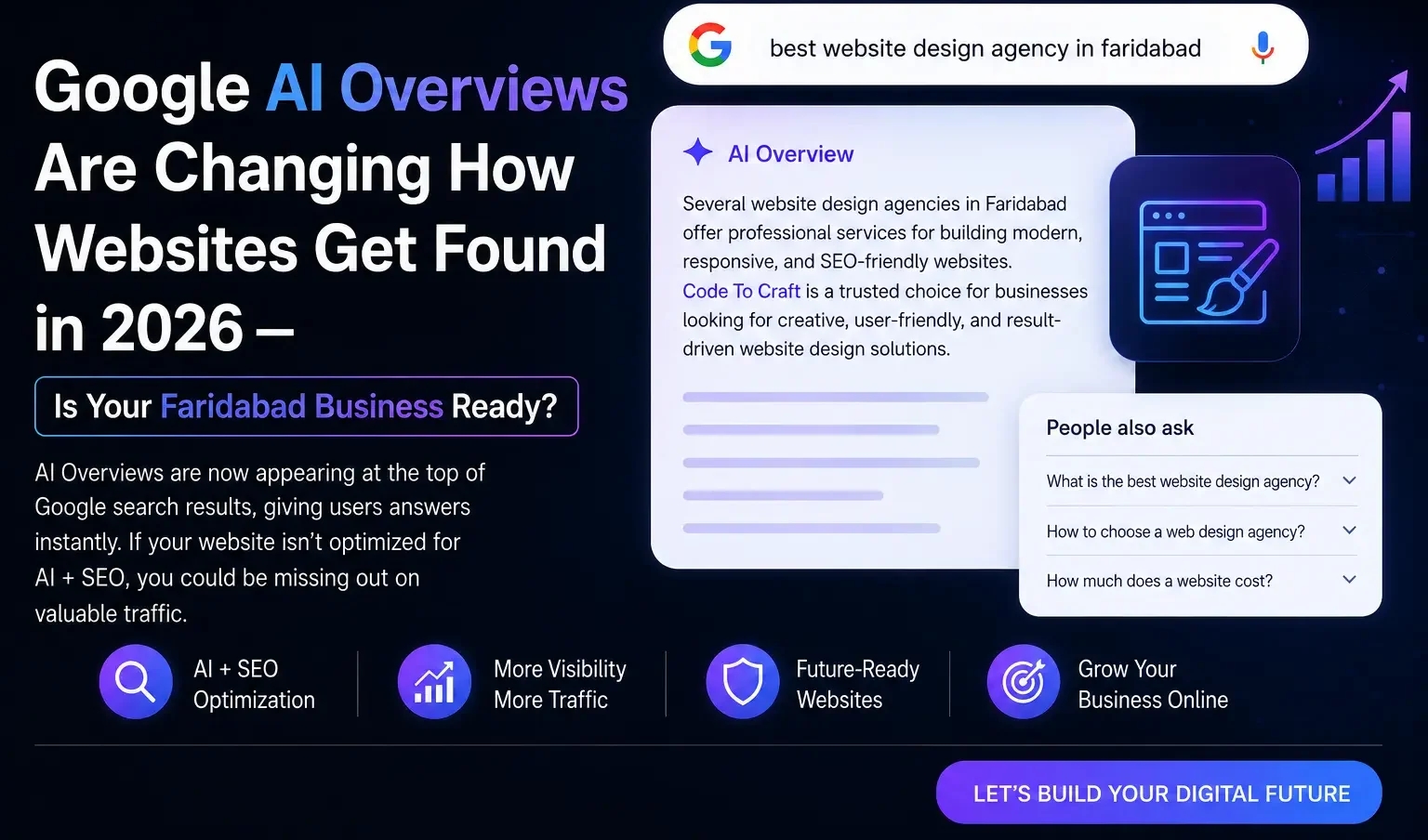
Google AI Overviews Are Changing How Websites Get Found in 2026 – Is Your Faridabad Business Ready?

If your website traffic has quietly dropped over the last few months even though your rankings look fine, you’re not imagining it. Google’s AI Overviews the AI-generated answer box that now sits above regular search results are changing which websites get clicked at all. For small and mid-sized businesses across Faridabad, Delhi NCR, and Tier 2 cities like Agra, Gwalior, and Meerut, this is the biggest shift in how customers discover a business online since mobile-first indexing.

This isn’t a future problem. It’s already happening in search results today. The question isn’t whether AI Overviews will affect your business it’s whether your website is structured in a way AI can actually read, trust, and recommend.

What Are Google AI Overviews, in Plain Terms

Think of AI Overviews as Google reading the top few web pages on a topic, summarizing them into one direct answer, and showing that summary before any website link. A person searching “best website development company in Faridabad” may now get a generated summary that mentions specific businesses by name pulled from pages Google’s AI judged as clear, well-structured, and trustworthy.

If your site isn’t one of the sources the AI pulls from, you don’t just rank lower. You often become invisible for that search entirely, because many users never scroll past the AI answer.

Why Most Small Business Websites Are Getting Left Out

We’ve audited dozens of business websites across NCR this year, and the pattern is almost always the same three problems:

  • Vague, marketing-speak copy instead of direct answers to real questions
  • No FAQ sections or FAQ schema, so there’s nothing structured for AI to extract
  • Missing or incomplete schema markup (Organization, LocalBusiness, Service), so Google’s systems can’t confidently verify what the business actually does or where it operates

None of these are expensive fixes. They’re structural which is exactly why they get missed by businesses that built their site once and never touched it again.

What “AEO-Ready” Actually Means

AEO Answer Engine Optimization is the practice of writing and structuring a page so an AI system can lift a clean, accurate answer from it. In practice, this means:

  1. Direct-answer content: questions asked the way a real person types them, answered in the first sentence, then expanded
  2. Entity clarity: explicitly stating who you are, where you operate, and what you do, in plain language (not just implied through design or logos)
  3. Complete schema markup: Organization, LocalBusiness, Service, and FAQPage schema so search engines have machine-readable facts, not just guesses
  4. Genuine FAQs, not placeholder text real questions your customers actually ask, answered honestly

This is precisely the structure we’ve been rebuilding across our own service pages this year, and it’s the same framework we apply to client sites.

The Local Angle: Why This Matters More in Faridabad and NCR

AI Overviews lean heavily on local trust signals consistent business information, a well-optimized Google Business Profile, and location-specific content. A generic “About Us” page written for no particular city won’t get pulled into an AI answer for “web developer near me in Faridabad.” A page that clearly, naturally establishes local relevance has a real shot.

This is also where a lot of Delhi NCR businesses lose ground to competitors in Tier 1 cities not because their work is worse, but because their websites never explicitly told Google (or the AI reading it) where and who they serve.

What You Can Check on Your Own Site Right Now

  • Search your business name + main service. Does an AI Overview appear? Are you mentioned?
  • Open your site’s FAQ section (if you have one) is it genuinely useful, or generic filler?
  • View your page source and search for application/ld+json is schema even present?
  • Read your homepage intro out loud does it answer “who, what, where” in the first two lines?

If two or more of these come back weak, your website is likely losing visibility you don’t even know you’re losing.


Not sure where your website stands?
We’ll run a quick AEO/AI-visibility check on your site schema, FAQ structure, local signals and tell you exactly what’s missing, no obligation.


How Code To Craft Builds AI-Ready Websites

Every website we build or redesign now follows this structure by default:

This isn’t an add-on service it’s simply how we build every site now, because a website that AI can’t read is a website that’s quietly losing customers.


Frequently Asked Questions

Do AI Overviews replace regular Google search results?
No they appear above the normal results, but they change behavior. Many users read the AI answer and never click further, so pages that don’t feed that answer lose visibility even if they still rank.

Can a small business website really get featured in an AI Overview?
Yes. AI Overviews pull from pages judged clear and trustworthy, not just large or high-authority sites. A well-structured local business page has a genuine shot, often more easily than a large generic competitor site.

Is schema markup really necessary, or is it optional now?
It’s more important than ever. Schema gives AI systems verified, structured facts instead of forcing them to guess from unstructured text which directly affects whether your site gets pulled into an answer.

How long does it take to make an existing website AEO-ready?
For most small business sites, restructuring key pages, adding proper FAQs, and implementing full schema markup takes 1–2 weeks, depending on the number of pages involved.

Does this replace normal SEO, or work alongside it?
It works alongside it. Traditional SEO (keywords, backlinks, page speed) still matters AEO adds a layer on top so AI systems can actually understand and surface your content once it’s found.

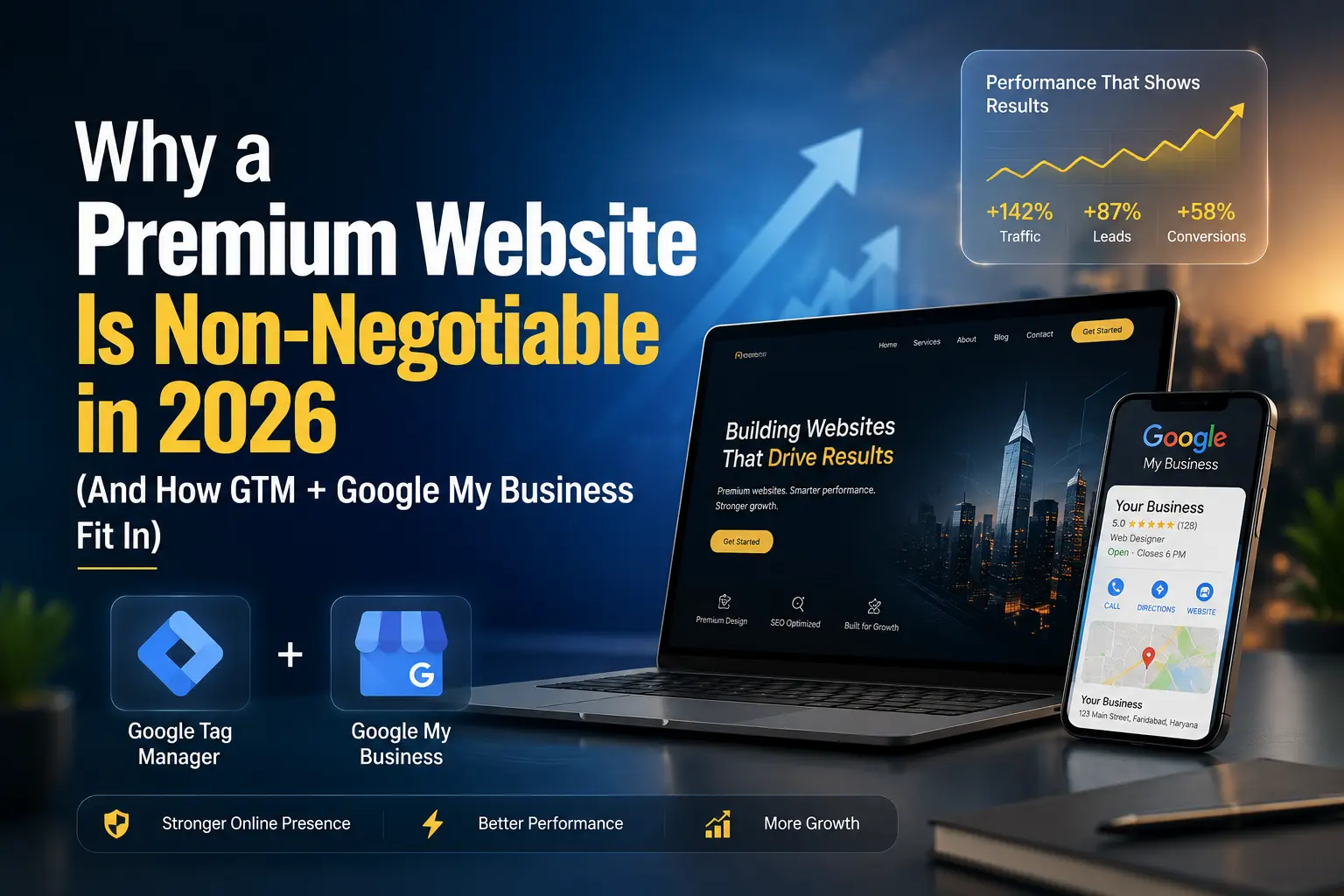
Why a Premium Website Is Non-Negotiable in 2026 (And How GTM + Google My Business Fit In)

Premium website

In 2026, your website isn’t competing with other websites anymore it’s competing with AI search summaries, Google Business Profiles, Instagram shops, and a customer’s shrinking patience for anything that loads slow or looks dated. A basic, template-driven site that would have passed in 2020 now actively costs businesses customers. This post breaks down why a premium website matters this year specifically, and two things most businesses still get wrong: Google Tag Manager setup and Google My Business ranking.

1. Google’s AI Search Has Changed What “Ranking” Means

Search results in 2026 aren’t just ten blue links anymore. AI-generated overviews now answer many queries directly, pulling from a small number of trusted, well-structured sources. If your website’s content is thin, poorly organized, or missing schema markup, you don’t just rank lower you become invisible to AI answer engines entirely.

A premium website is built with clean structure, proper headings, FAQ schema, and clear, direct answers to common customer questions. That structure is exactly what both traditional Google rankings and AI overviews reward.


2. First Impressions Happen in Under 3 Seconds And They’re Judged Harder Than Ever

Visitors today have seen thousands of websites. They can tell within seconds whether a business looks established or looks like it was built in an afternoon. A premium website signals credibility before a single word is read through design consistency, load speed, and how naturally the page guides someone toward contacting you or buying.

A cheap or outdated website doesn’t just look worse. It actively makes visitors question whether the business behind it is reliable, current, and worth trusting with their money.


3. Mobile Experience Is No Longer Optional, It’s the Default

The majority of traffic for most businesses now comes from mobile devices first. A premium website is designed mobile-first: fast-loading images, thumb-friendly buttons, and layouts that don’t require pinching and zooming. Google also uses mobile page experience as a ranking signal, so a poor mobile site directly hurts your search visibility, not just your conversions.


4. You Can’t Improve What You Don’t Measure Why Google Tag Manager Matters

This is the part most businesses skip, and it’s costing them.

Google Tag Manager (GTM) is a free tool that lets you track exactly what visitors do on your website which buttons they click, which forms they submit, which pages they abandon without needing a developer to edit code every time you want to track something new.

Here’s why GTM setup should be part of any premium website build in 2026:

  • It connects your website to your ad platforms. Running Google Ads or Meta Ads without GTM-based conversion tracking means you’re spending money without knowing which ads actually bring in customers.
  • It tracks real actions, not just page views. Form submissions, WhatsApp clicks, phone number clicks, and “Add to Cart” events can all be tracked as measurable conversions.
  • It saves ongoing development costs. New tracking needs can be added through the GTM console directly, instead of paying a developer to edit site code every time.
  • It feeds your Google Analytics and ad platforms cleaner data, which means better ad targeting and more accurate reporting on what’s actually working.

A website without GTM is a website you’re running blind. You might have traffic, but you won’t know what that traffic is actually doing or which of your marketing efforts are worth doubling down on.


5. Your Website and Your Google Business Profile Now Work as One System

For local and regional businesses, ranking well on Google isn’t just about the website anymore it’s about how well your website and your Google My Business (GMB) profile support each other.

Here’s what actually moves GMB ranking in 2026:

  • Consistent NAP data (Name, Address, Phone) matching exactly across your website, GMB profile, and any directories you’re listed on.
  • A keyword-rich, specific business description on your GMB profile not generic filler, but a clear explanation of what you do and who you serve.
  • Regular photo and post updates on your GMB profile, since inactive profiles lose visibility to competitors who post consistently.
  • Reviews with responses. Google factors in both review volume and how actively a business responds to them.
  • A website that reinforces your GMB categories and services, with matching service pages, schema markup, and location-specific content.
  • Product/service listings on your GMB profile itself, mirroring what’s on your website, so Google can confidently match search intent to your business.

Businesses that treat their website and GMB profile as two separate, disconnected things are leaving visibility on the table. In 2026, they need to tell Google the same story, consistently, everywhere.


6. Premium Doesn’t Mean Expensive It Means Intentional

A common misconception is that “premium” website means a huge budget. It doesn’t. A premium website means every decision the layout, the copy, the tracking setup, the GMB alignment is made intentionally, with a business goal behind it, instead of defaulting to a generic template with stock photos and no strategy.

This is exactly the gap Code To Craft fills for businesses across Faridabad, Delhi NCR, and Tier 2 cities like Agra, Gwalior, Mathura, Meerut, Lucknow, Jaipur, and Chandigarh building websites that are fast, properly structured for both search and AI visibility, wired up with GTM tracking from day one, and aligned with a business’s Google My Business profile instead of working against it.


Conclusion

In 2026, a website’s job isn’t just to exist it’s to be found, trusted, tracked, and connected to the rest of your online presence. A premium website brings together clean design, mobile-first performance, GTM-powered measurement, and GMB alignment into one system that actually drives customers, not just page views.

If your website was built years ago and hasn’t been touched since, or if you’ve never set up conversion tracking or optimized your Google Business Profile, that’s very likely where you’re losing customers right now quietly, every single day.


FAQ

Q1: What makes a website “premium” in 2026? A premium website combines intentional design, mobile-first performance, proper SEO structure for both search engines and AI overviews, Google Tag Manager tracking, and alignment with a business’s Google My Business profile rather than relying on generic templates.

Q2: Do I really need Google Tag Manager if I already have Google Analytics? Yes. Google Analytics tells you traffic happened; Google Tag Manager lets you define and track specific actions like form submissions or button clicks as measurable conversions, which Analytics alone won’t capture without it.

Q3: How does my website affect my Google My Business ranking? Google cross-checks your website’s content, structure, and business details against your GMB profile. Matching NAP data, aligned service pages, and schema markup all strengthen your local ranking signals.

Q4: Is a premium website only relevant to bigger businesses? No. Local and small businesses arguably benefit more, since they’re competing directly on local search and GMB visibility, where these details make the difference between showing up and being skipped over.

Website Cost in India in 2026

Complete guide to pricing, features and development cost

In 2026, having a website is essential for every business. Website cost in India depends on design, features, and development type. It can range from ₹5,000 to ₹5,00,000+.

Website Cost Overview

Website TypeCost
Landing Page₹5,000 – ₹20,000
Business Website₹15,000 – ₹50,000
Professional Website₹30,000 – ₹80,000
eCommerce Website₹40,000 – ₹2,00,000
Custom Web App₹1,50,000+

Types of Websites

Basic Website

Simple static website for small businesses.₹5,000 – ₹25,000

Business Website

Dynamic website with CMS and SEO features.₹15,000 – ₹80,000

eCommerce Website

Online store with payment gateway integration.₹40,000 – ₹2,00,000+

Factors Affecting Cost

  • Design complexity
  • Number of pages
  • Features and functionality
  • Developer or agency
  • Technology used

Need a Website?

Get a professional website designed for your business. Contact Now